Every Breath We Take.
Kerry Atebe (Kenya)
Honorable Mentions
It is late at night in Mukuru kwa Reuben, one of the many informal settlements in Nairobi Kenya. From a distance, towering smokestacks billow out pillars of smoke into the sky. Some of it lingers, ominously snaking its way into the surrounding residential houses, where with each breath of the sleeping inhabitants it fills their lungs.
Air pollution is increasingly becoming a worldwide environmental health risk and a major contributor to the global burden of diseases. The World Health Organization (WHO, 2019) has shown that people living in low and middle income countries bear the largest air pollution related burden. 91% of the 4.2 million annual deaths attributed to ambient air pollution occur in these countries. Epidemiological studies have strongly associated air pollution and diseases of public health importance such as cancers, respiratory and cardiovascular disease. The increase in related morbidities and mortalities are the ramifications of human activities that result in initially invisible but progressively tangible effects.
Let’s go back in time circa 10 000 B.C. Humans began the shift from hunting and gathering to a more settled lifestyle. Fast forward to the turn of the 18th century when what is considered as the second agricultural revolution began in different parts of Europe. The introduction of better farming techniques resulted in greater crop yields and the ability of man to support more livestock. The end result? An increase in the general population. More people meant more labour was available for emerging industries thus contributing to the advent of the industrial revolution.
Industry for the most part has largely been sustained by fossil fuels. Even though modern science has uncovered alternative sources of clean energy exemplified by the myriad of options of renewable and nuclear energy, we still rely heavily on the aforementioned fossil fuels. This brief refresher in history is important because it helps us acknowledge that air pollution is not the effect of a singular event but rather, the culmination of a series of processes that have occurred over the years. Admittedly, this was not the intention of these two redefining eras in the history of mankind but our current predicament as humanity, is their effect.
One cannot discuss air pollution without mentioning climate change. It is the greatest problem collectively facing humanity and has devastating effects. Many areas globally, are currently experiencing a decrease in water supply which translates into crop failure, food insecurity, poverty and ultimately, a crippled economy. June - July in Kenya is traditionally regarded as the cold season but in 2019, these two months have been anything but cold. On some days, the heat rivaled that experienced during our hottest months, January and February. These dramatic changes in weather patterns are not isolated occurrences. Similar erratic weather events have increasingly been reported the world over. Our complicity has jeopardized nature. Research models predict that in the coming years, climate change will result in the sixth mass extinction. If left unchecked, the destructive feedback loop between air pollution and climate change will leave generations down the line to deal with unprecedented and potentially disastrous consequences.
What causes air pollution? Let’s expound on the fossil fuels I mentioned earlier. Combustion of these fuels produces carbon dioxide which is the largest contributor to global warming. It is emitted as we sit in our cars during rush hour, as a byproduct of industrial processes and commonly in developing countries, as an aftermath of pervasive use of polluting hydrocarbon fuels such as kerosene for cooking and lighting.
Other pollutants include methane, which is more potent than carbon dioxide and particulate matter such as soot, produced by burning solid biomass fuels like coal. It is disconcerting to accept that our mundane tasks are insidiously fuelling our destruction. Currently, our global footprint exceeds the global biocapacity. Carbon emissions alone are responsible for 60% of the overall footprint as stated by the Global Footprint Network, 2019. The Amazon fires have compounded the situation by reducing the capacity to absorb these emissions. According to Christian Aid, a UK development charity, countries like Burundi and Sierra Leone are least responsible for said emissions but end up being disproportionately impacted by steadily rising carbon dioxide concentrations.
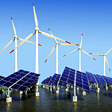
As pre- apocalyptic as all this sounds, it should be emphasized that all is not lost. We are at a critical point of reversible damage. Measures can be taken to ameliorate our situation. From international treaties that influence government policies right down to community decisions on local development and resource utilization. Even as individuals, we can make such a difference. It is as simple as switching to low carbon energy sources like solar energy, deciding to use the public transport system as opposed to your own vehicle, planting a tree or at the very least, disposing of your used serviette in the bin marked “paper”.
Terms like carbon neutral and decarbonized economies sound quixotic but it all comes down to decisive action. Practical solutions like monitoring air quality and verifying set standards are met via provision of sensors and guides for interpreting data, employing the use of renewable energy production, ensuring access to clean household energy, improving the efficiency of our transport systems, revising policies on urban planning and waste management and utilizing carbon pricing as a fiscal incentive thus guaranteeing that emitters are held culpable for their emissions will see us gain massive health and economic benefits (WHO, 2019).
The Paris Agreement marked an important step we took in tackling climate change. It is highly ambitious in its call for universal participation to reduce global temperature below 20 C and to limit the increase to 1.50 C. Countries like Morocco and Gambia are well on track to achieving their nationally determined contributions with the former having invested massively in solar energy. Most parties however, are not doing enough. The U.S, Russia and Saudi Arabia have been rated by the Climate Action Tracker as critically insufficient, serving only to undermine progress. Despite current challenges, with conviction and timely action there is a chance of positive outcome.





 |
| 
 0
0








0 Comments