BIODIVERSITY LOSS- THE MOST IGNORED EXISTENTIAL CRISIS
Monita Priyadarshini (India)
Honorable Mentions
The news was flashing horrific scenes of a devastating flood which completely washed away our old neighbourhood. I was studying in my room when my father suddenly called me to watch the news. When I asked my father,“ It hardly even rains there! How can there be a flood all of a sudden?” He replied,” in order to build more homes, they cut down all the trees alongside rivers which used to hold the soil in place with their roots.” A shiver ran down my spine when I realised that all the natural disasters this year are actually man made.
When I saw a strong mango tree being uprooted by the waters, the memories of my childhood crossed my mind. We used to live near that tree. It gave us everything, like a father, from food to shelter. My innocent mother used to feed us mangoes from that tree when we couldn’t afford food. Now that we have a little more privilege these days, we have somehow forgot to do anything for the tree. Now it’s dead.
Swimming in my pool of thoughts, I realised many animals died in the flood too. Thousands of cows and sheep were helplessly roaming on the streets when a gush of grey waters hit them suddenly and landed them in an unknown location.
Not only floods, other natural phenomenon also affect our biodiversity. Due to deforestation, overexploitation of ground water and land, increase in human population, climate change and pollution, many animals and birds are dying and some species are becoming extinct, affecting ecosystem. There are many detrimental effects on biodiversity due to direct and indirect human activities. Direct human activities includes introduction and removal of species, air and water pollution, harvesting and climate change. Indirect human activities includes demographic, economic and religious and cultural factors.
For agriculture and habitation purpose, forests are being wiped away. As a result, animals are forced to adapt to the changes in the environment or migrate to other places. Unable to do so, species become targeted to predation, starvation and death. Pollution makes survival difficult for the species as it changes their natural habitat.
The population growth is a major factor in nourishing the demand of natural resources. It leads to significant waste generation, which is a major cause of pollution. In atmosphere the increased concentration of carbon monoxide causes climate change. Carbon dioxide can’t be absorbed due to large- scale cutting of trees every year and its concentration increases in atmosphere. Pollution eventually leads to ocean acidification, extreme weather events, melting of sea ice, sea-level rise, pandemics and epidemics, interrupted seasonal cycles which affects the innocent animals and birds.
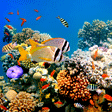
According to data, the pH level of water in oceans has fallen drastically by 30%, affecting aquatic species severely. Coral reef, which serves as a habitat for a lot of marine species, is being depleted due to bleaching.
Water pollution has deleterious effect on the biotic component of coastal ecosystem. The entire food chain get disturbed when toxic waste entering into the water body. Floods, drought, cyclones, forest fires, earth-quakes and other natural calamities take a large number of plant and animal life.
For zoos and biological laboratories animals and plants are collected. This is done for research and medical purposes. Generally, primates like monkeys and chimpanzees are sacrificed because their anatomical, genetic and physiological similarity to human beings.
Humans depend largely on biodiversity. The loss in biodiversity may seem unimportant to humans who are busy taking much advantage from our ecosystem, but if affects the well-being of humans, which is nothing compared to a short term material advantage.
Change in ecosystem and loss in biodiversity is causing poverty and affecting livelihoods. In the world the economic cost of biodiversity tops the list. If nature is unable to take care we will have to pay for costs of pollination, irrigation and soil reclamation. Bad agricultural practices cause outbreak of pests and pathogens which can ultimately cause environmental stress. Food security based on ecosystem is being threatened now, lacking important micronutrients which is very important for our health. Depletion of some species badly affects pharmaceutical industry as well, depriving it from natural medicinal raw material.
“Reduced biodiversity creates a kind of ecosystem homogenization across regions as well as throughout the biosphere. Specialist species (those who have adapted to narrow habitats, limited food resources or other specific environmental conditions) are often the most vulnerable to dramatic population declines and extinction when conditions change.”(Britannica)
Destroyed food chain is causing modified interaction among organisms which is giving birth to some infectious diseases passed down to humans. The COVID-19 pandemic of 2020 has now killed people more than a crore. Many countries have slipped to recession because of the pandemic.
I can go on and on about causes and effects of biodiversity loss, but we really need to understand the gravity of our current situation in the world. CLIMATE CHANGE IS ALREADY HERE. BIODIVERSITY LOSS IS ALREADY HAPPENING. The substantial amount of damage is already done. The need of the hour is a mass movement and conservation practices at individual level. Reducing over-consumption of resources, introducing “eco-farming”, by using energy efficient appliances at our homes to save energy, by conserving water wetlands and managing livestock grazing. The global environmental initiatives about biodiversity security should be encouraged and supported.
The natural disasters in 2020 is a wake-up call for us all. We can’t totally reverse the biodiversity loss incurred by us, but we can definitely take this problem seriously and act on individual level.In order to feel the consequences at heart, you can imagine your future generation being washed away in the flood.





 |
| 
 0
0





0 Comments