Unknown plagues are on their way
By Science Columnist Ho-Gwan Ko
2020 will be remembered as the year of COVID-19. A number of people around the world have had this disease, and some of them have died. Social distancing practiced for the purpose of stopping the spread of COVID-19 has led to a recession and also changed our way of life. This is an example of how much a single infectious disease can affect society.
We are highly likely to face more of such pandemics in the future because of climate change. Most infectious diseases that harm people are often transmitted by animals. Insects such as mosquitoes and flies and animals like mice act as the carriers of diseases. As temperatures rise, the range and duration of their activity increase. Even extreme weather conditions including typhoons and heavy rains that become frequent due to climate change can lead to many water-borne diseases such as cholera and typhoid.
In addition, the higher the water temperature, the better the bacteria will grow. One of the typical examples is Vibrio vulnificus infection. The disease is caused by bacteria entering the bloodstream. As Vibrio bacteria multiply when the sea temperature is high, people get infected usually in summer by getting seawater on an open wound or by eating raw shellfish. It’s a serious illness that can lead to death if not treated.
The growth of Vibrio bacteria is closely related to the sea temperature. The bacteria spread when the water temperature is over 18-20°C. As the water temperature rises due to climate change, the period when Vibrio bacteria are active gets longer. This means that more people could get vibriosis.
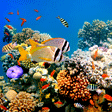
.jpg) ▲ Global warming increases the chances of people getting sick by accelerating the growth of harmful bacteria.
▲ Global warming increases the chances of people getting sick by accelerating the growth of harmful bacteria.
It’s not just humans that are affected by infectious diseases increasing due to water temperature changes. More bacteria are surviving the warmer winters than ever before and multiply, causing disease in marine life. When species that provide habitats for many other marine life, such as coral reefs and eelgrasses, become sick and fragile, other organisms depending on them are also put at risk.
There is also the possibility that frozen bacteria or viruses may be released and cause new diseases. Glaciers in the polar or alpine regions are formed when snow accumulates over time. Bacteria and viruses floating in the air at that time also accumulate with snow. As hundreds of thousands and millions of years passed, all the snow piled up and pressed by the weight has become today’s glaciers. In other words, glaciers may contain bacteria or viruses from the past that we are not familiar with.
When the glaciers melt due to global warming, these microorganisms will be released and will likely be activated. Viruses have a much simpler structure than bacteria and are more likely to revive themselves. They come from ancient times and we know nothing about them. Therefore, if they infect humans or animals and cause diseases, it will be very difficult to deal with.
What is more worrisome and difficult to deal with is that they can disturb the ecosystem of the Earth. It’s hard to predict what will happen if genes of unknown ancient microbes mix with the modern ecosystem. Even now, a great amount of microbes are being released every year as glaciers melt. It’s also possible that they make their way into our body through rivers and lakes.
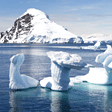
.jpg) ▲ Can we cope with ancient viruses that have been sleeping in the ice?
▲ Can we cope with ancient viruses that have been sleeping in the ice?
In fact, anthrax spread in Siberia in 2016, killing thousands of reindeer and infecting humans. It was surprising because it had been 75 years since anthrax broke out in this region. An investigation found that the leading cause was global warming. Not long before the anthrax outbreak, the region had abnormally high temperatures, melting the permafrost. It’s speculated that the bacteria revived from the corpse of a person or an animal that died of anthrax in the past and infected the reindeer.
We shouldn’t be relieved just because the source of an infectious disease has been controlled. Let's take the example of saiga antelopes that live in Eurasian steppes. More than half of this endangered species died en masse in the spring of 2015. An investigation revealed that the cause was sepsis resulting from bacterial infection. However, the bacteria that caused the infection were a harmless variety that could be found in many animals. Scientists have speculated that global warming may have made the bacteria adapt to the new environment and become fatal or the saiga antelopes stressed out by climate change had lost immunity.
As can be seen from the COVID-19 outbreak, the elderly are more vulnerable to the epidemic. It will be more difficult for us to fight against diseases if our body is stressed and weakened when the number of deadly pathogens increases due to climate change. Epidemics are another good reason to stop climate change.





 |
| 

 1
1






1 Comments
Thank for sharing
Posted 07-08-2021 19:42