
Environmental Networking Platform for Children and Youth by SAMSUNG E&A



Stay connected with Eco-generation :


| Share  |
| 
- Home >
- Resources >
- Climate Change
[Climate Change] Column【9】Reduce carbon dioxide in the air! |
|---|
|
by Eco Generation | 20-01-2021 09:09
|
|
Reduce carbon dioxide in the air!
By Science Columnist Ho-Gwan Ko
Climate change is already happening. Even if we reduce carbon dioxide emissions with tremendous efforts, that alone is not enough as a large amount of carbon dioxide has already flowed into the atmosphere. We need to reduce carbon dioxide emissions and remove the gas already in the atmosphere at the same time to prevent impending disasters.
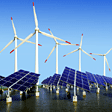
▲ Carbon capture and storage technology is efficient for places that emit large amounts of carbon dioxide, including power plants.
Of course, it can also be applied to fossil fuel use. Although the amount of carbon dioxide in the atmosphere will not be decreased, we can at least prevent the gas from being released. Carbon capture and storage technology is used for places that emit large amounts of carbon dioxide, such as power plants. The collected carbon dioxide is stored deep underground in gas or solid form. However, this technology requires extra cautions because carbon dioxide can escape in the case of accidents such as earthquakes.
|
|
|
 0
0
.jpg)

- [Eco Column] Reshape the Earth[1]
- [Eco Column] How to Save the Earth Using Math[6]
- Column【10】Even if we have to sacrifice what we enjoy[7]
- Column【9】Reduce carbon dioxide in the air![0]
- Column【8】Is the Internet free from greenhouse gases?[2]
- Column【7】Is there meat not contributing to greenhouse gases?[1]
- Column【6】How should we eat to stop global warming?[3]
- Column【5】Disasters caused by global warming accelerate global warming[0]
- Column【4】Unknown plagues are on their way[1]
- Column【3】The oceans are in danger[5]
- Column【2】Disappearing and unwelcome lives[0]
- Column【1】Limit global temperature rise to below 1.5˚C[0]
- 7 Environmental Elements You Should Know_Climate Change[2]
- [Fun Environmental Stories through Numbers] An Hour that changes the world[9]
- [Fun Environmental Stories through Numbers] 2050 Farewell to the things we love[5]








0 Comments